
```html
Hisense RGB Mini LED: What It Is and How the Technology Evolved
RGB Mini LED is one of the newest steps in display backlighting, aiming to push LCD TVs closer to the color control and contrast people associate with emissive technologies. Hisense has been among the brands highlighting RGB Mini LED as a next-generation approach—one that changes not just how bright a TV can get, but how precisely it can create color and shading across the screen.
Mini LED in One Sentence
A Mini LED TV is still an LCD TV, but instead of using a small number of relatively large LEDs behind the panel, it uses thousands (sometimes tens of thousands) of much smaller LEDs that can be controlled in many local dimming zones to improve contrast and brightness control.
From LED LCD to Mini LED: A Short History
1) CCFL LCD: The early era of flat panels
Early LCD televisions used CCFL (cold-cathode fluorescent lamp) backlights. They were relatively thick, less efficient, and offered limited control over brightness across the screen. Blacks often looked gray because the backlight illuminated large areas at once.
2) White LED backlighting: thinner, brighter, more efficient
The shift to LED backlights (typically blue LEDs with a yellow phosphor to create “white” light) enabled thinner designs, better energy efficiency, and higher peak brightness. Two common layouts emerged:
- Edge-lit LED: LEDs on the edges shine through light guides. Thin, but limited local dimming control.
- Full-array local dimming (FALD): LEDs spread behind the panel, allowing zones to dim independently.
FALD improved contrast dramatically, but the number of zones was still limited because LEDs were relatively large, and the electronics required to control many zones were costly.
3) Quantum dots: stronger color, same basic backlight
Quantum-dot (QD) enhancement films improved color volume—especially at high brightness—by converting parts of the blue backlight into very pure red and green wavelengths. Many “QLED” style TVs are essentially LED LCDs with quantum dots. However, the backlight itself was still typically “white” light feeding an LCD color filter.
4) Mini LED: more zones, better control
Mini LED shrinks the LED package size, letting manufacturers place far more LEDs behind the LCD. More LEDs make it practical to create far more dimming zones, reducing haloing (blooming) around bright objects on dark backgrounds and improving black levels while maintaining very high brightness for HDR.
What Makes RGB Mini LED Different?
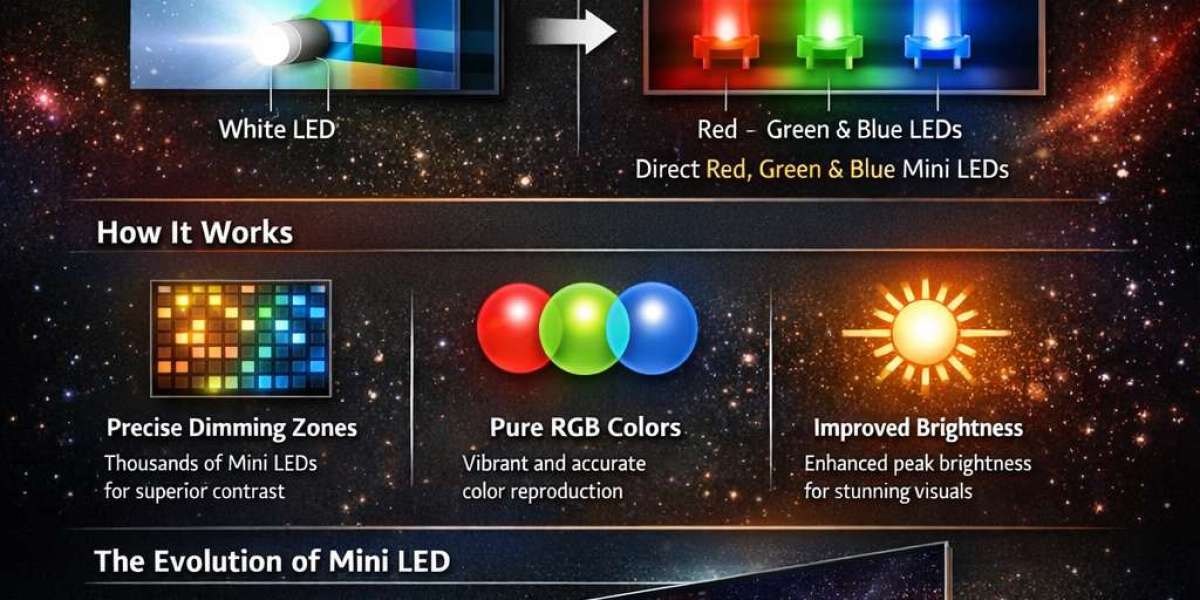
Most Mini LED TVs use a white backlight (often blue LEDs + phosphor, sometimes paired with quantum dots) and then rely on the LCD’s color filters to produce red, green, and blue at each pixel. RGB Mini LED changes the idea of the backlight itself:
RGB Mini LED uses separate red, green, and blue LEDs in the backlight system (arranged and controlled in groups/zones), rather than generating white light and filtering it afterward. In principle, this enables more direct control of color and can improve efficiency because less light is “wasted” by color filters.
Key concept: local dimming becomes local color control
Standard Mini LED local dimming primarily controls brightness per zone. With RGB Mini LED, the TV can control brightness and color mix of the backlight per zone. The LCD layer still modulates the final image, but the backlight can provide a closer “starting point” for the intended color in that area.
Hisense and RGB Mini LED: The Goal
Hisense positions RGB Mini LED as a way to improve three things viewers notice most in real content: color accuracy, color volume (saturated colors at high brightness), and contrast (especially in HDR).
- Higher color volume at high brightness: By producing red/green/blue light in the backlight rather than relying only on filtering white light, RGB Mini LED can help maintain richer colors when HDR scenes get very bright.
- Potentially better efficiency: If the backlight creates the needed color more directly, the system may require less overall light output to hit the same on-screen color, because fewer photons are blocked by filters.
- Finer control over challenging scenes: Bright highlights, neon signage, sunsets, and mixed-light scenes can benefit when the backlight can “pre-shape” both intensity and hue locally before the LCD does final pixel-level modulation.
It’s important to note that RGB Mini LED is still not per-pixel light emission (as with OLED or MicroLED). Control happens in zones, so the number of zones and the dimming algorithm still matter a lot for blooming, shadow detail, and subtitles on dark scenes.
How RGB Mini LED Fits Into the Bigger Display Technology Timeline
RGB Mini LED can be seen as a bridge between traditional LED LCD and fully emissive displays:
- Compared with conventional Mini LED: RGB Mini LED changes the backlight from “white + filters” to “color-tunable light,” potentially improving color performance and control in HDR.
- Compared with OLED: OLED offers pixel-level contrast and no backlight blooming, but can be limited in sustained peak brightness and carries different longevity considerations. RGB Mini LED targets very high brightness with improved color handling.
- Compared with MicroLED: MicroLED is emissive and can offer exceptional brightness and longevity, but is currently expensive and difficult to manufacture at mainstream TV sizes. RGB Mini LED is designed to be more scalable today using advanced LCD backlighting.
Challenges and Trade-Offs
RGB Mini LED is technically ambitious. Driving separate red, green, and blue LEDs across many zones increases complexity in several ways:
- More sophisticated calibration: The TV must keep color stable across brightness levels and over time.
- More complex control algorithms: The processor must decide not only how bright each zone should be, but what color mix it should output without introducing artifacts.
- Potential for color fringing in extreme cases: If zone transitions are not well managed, edges between different colored zones could become noticeable. Strong processing and dense zoning help reduce this.
Why It Matters for Viewers
In everyday terms, Hisense RGB Mini LED is about making HDR look more lifelike: bright highlights that pop, deep-looking dark scenes, and vivid colors that don’t wash out when the picture gets intense. It also represents a broader industry trend—pushing LCD technology further through smarter backlights and better control, even as OLED and MicroLED continue to evolve.
```


