

Sony True RGB Mini LED Explained: How It Works and What It Changes
Sony True RGB is an advanced LCD television system that replaces the usual blue or white Mini LED backlight with independently controlled red, green, and blue LEDs. This guide explains how the technology improves bright colors and HDR performance, how it differs from OLED and MicroLED, and which limitations consumers should still expect.
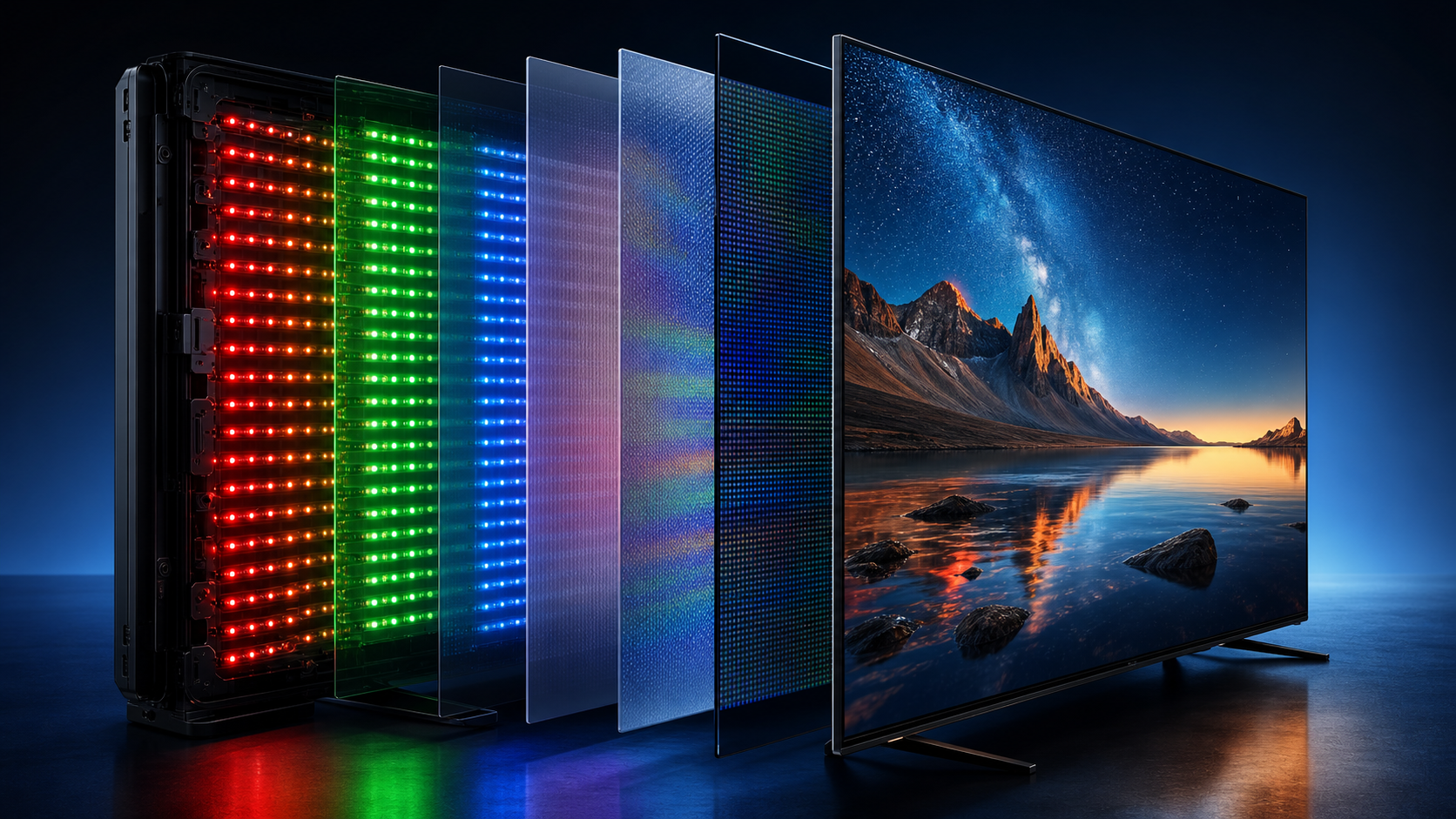
Mini LED televisions have become brighter and more precise, but most still create every on-screen color from a fundamentally colorless backlight. Sony’s True RGB changes that arrangement: the light behind the LCD already carries red, green, and blue information before it reaches the pixels.
That distinction can produce brighter saturated colors and reduce the pale, washed-out appearance that conventional LCD TVs sometimes show in demanding HDR scenes. It does not, however, turn the TV into a self-emissive display. True RGB remains an LCD system with local-dimming zones, so its benefits and limitations are different from those of OLED or MicroLED.
Sony introduced the first consumer True RGB models—the BRAVIA 9 II and BRAVIA 7 II—in May 2026. The technology is commonly described as RGB Mini LED, although Sony markets its implementation as True RGB and the underlying control system as RGB Backlight Master Drive Pro.
How a conventional Mini LED TV creates color
An LCD pixel does not generate light. A backlight shines through liquid-crystal shutters, polarizers and red, green and blue color filters. The LCD layer controls how much light passes through each subpixel, creating the final image.
In many modern quantum-dot Mini LED televisions, blue LEDs illuminate a quantum-dot conversion layer that produces narrow-band red and green light. The resulting light then passes through the LCD panel’s color filters. This design can reproduce a wide color gamut, but the backlight itself generally does not carry a spatially detailed color image. Its local-dimming zones mainly control brightness.
This creates two different resolutions inside the TV:
- The LCD panel controls millions of individual pixels.
- The Mini LED backlight controls a much smaller number of lighting zones.
A bright red object against black, for example, may require a backlight zone to produce broad-spectrum light across an area larger than the object. The LCD blocks the unwanted portions, but some light can leak through or spread into adjacent areas. This contributes to blooming and can make intense colors lose saturation as brightness rises.
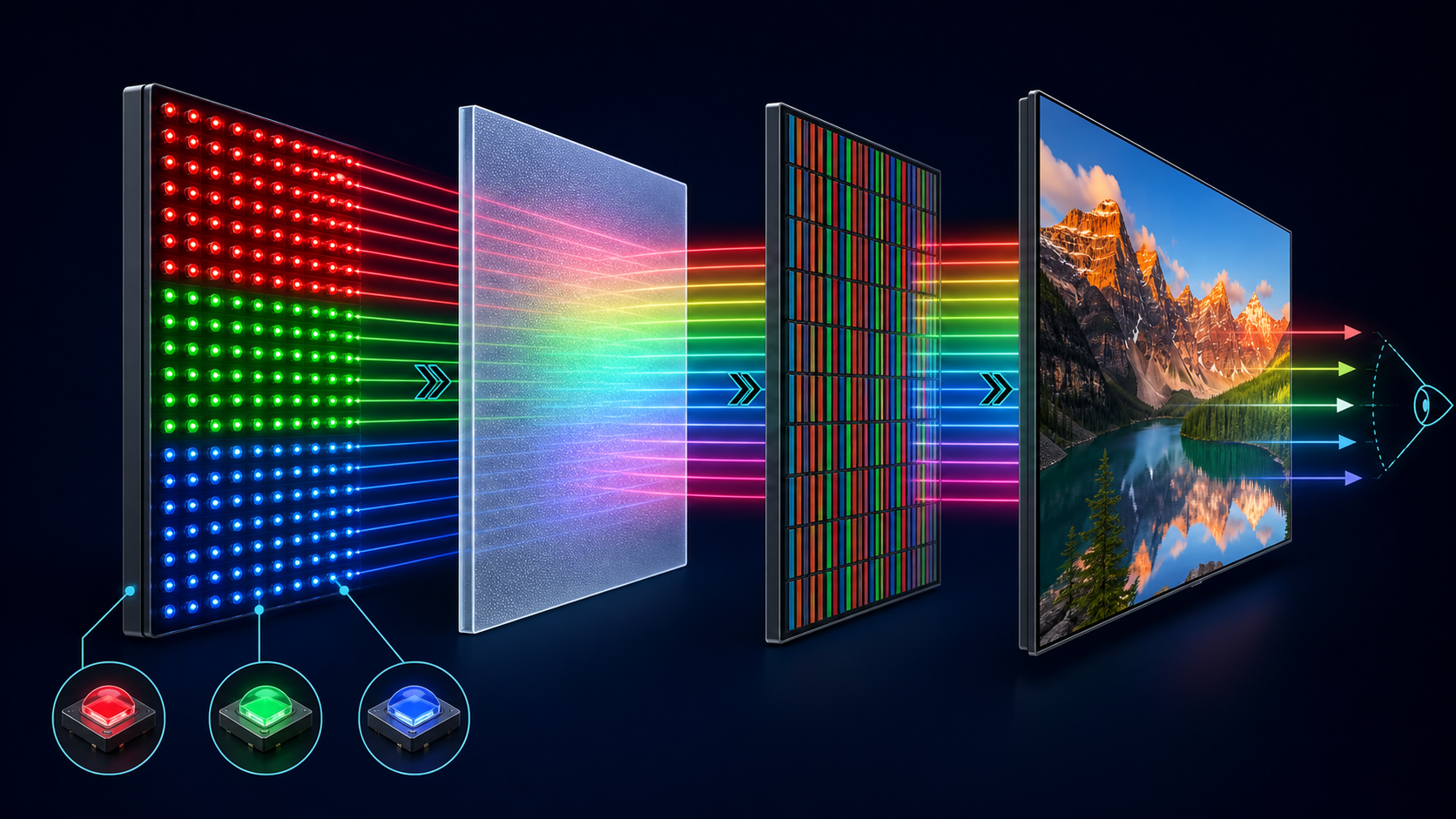
True RGB Mini LED uses independently controlled red, green, and blue emitters behind the LCD panel.
What Sony True RGB changes
True RGB replaces the conventional backlight’s single-color or converted light source with separate red, green and blue LEDs. Sony says its control system can drive those three primaries independently, allowing each local-dimming zone to vary not only in brightness but also in color composition. The company’s technical announcement from March 2025 describes a high-density backlight whose red, green and blue channels can emit independently.
The LCD panel still performs the final, pixel-level shaping of the image. True RGB therefore uses two color-forming stages:
- The backlight produces a relatively low-resolution map of colored light.
- The LCD subpixels refine that light into the full-resolution 4K image.
Sony describes this as creating color at both the backlight and LCD layers. Its True RGB technology overview says the approach is intended to suppress the white flare that can make conventional Mini LED images look washed out.
The important engineering challenge is coordination. The processor must determine the brightness of every local-dimming zone, calculate the appropriate balance of red, green and blue light, and then synchronize that backlight with the LCD image. Adjacent zones also affect one another because light spreads through the TV’s optical layers.
Sony calls the resulting control architecture RGB Backlight Master Drive Pro. The name refers to the complete combination of LEDs, drivers, optics, processing and dimming algorithms—not simply the use of three LED colors.
Why RGB backlighting can improve HDR color
Greater color volume
Color gamut describes the range of hues a display can reproduce. Color volume adds brightness to that measurement. A TV may reproduce a deep red at moderate brightness yet fail to retain the same saturation when asked to make that red extremely bright.
This distinction matters in HDR. Sunlit flowers, neon signs, flames, animated effects and intensely colored clothing may all combine high luminance with strong saturation. A conventional display can meet the requested brightness by adding more broad-spectrum or white light, but doing so may dilute the color.
An RGB backlight can direct more power to the required primary LEDs instead. A bright red area can receive predominantly red light rather than white light that the LCD must filter. The reasonable technical interpretation is that less unwanted light has to be absorbed or blocked, giving the display more headroom for bright, saturated colors.
Sony’s 2025 development system was reported to cover more than 99% of DCI-P3 and approximately 90% of the much larger BT.2020 gamut. Sony explicitly cautioned that those figures described the development platform, not every future retail product. DCI-P3 is associated with digital-cinema production, while ITU-R BT.2020 defines color primaries and other parameters for ultra-high-definition television.
Independent measurements show why product-level verification remains important. RTINGS measured the 65-inch BRAVIA 9 II at approximately 99.5% DCI-P3 and 82.6% BT.2020 color-volume coverage in its RGB configuration. Measurement methods and picture settings affect these percentages, so they should not be compared directly with Sony’s prototype gamut claims.
High brightness without immediately losing saturation
Sony’s development platform exceeded 4,000 cd/m² in peak-brightness demonstrations, although the company again noted that this was not a guaranteed retail-TV specification. RTINGS subsequently measured the BRAVIA 9 II at 4,720 cd/m² on a 10% HDR test window, while its full-screen result was much lower at 981 cd/m².
That difference illustrates why a single peak-brightness number never tells the whole story. Performance changes with window size, duration, picture mode, tone mapping and local-dimming behavior. The relevant True RGB advantage is not merely that the screen can become bright, but that strongly colored highlights can remain saturated at high brightness.
Potentially more natural blooming
RGB control cannot eliminate blooming because one backlight zone still illuminates many LCD pixels. It can, however, change the color of the leaked light. A red object may produce a dim red halo rather than a gray or whitish one, which can be less visually disruptive.
That is a plausible benefit rather than a universal guarantee. Blooming still depends on zone count, panel contrast, viewing position and the manufacturer’s dimming decisions. In its BRAVIA 9 II evaluation, RTINGS found deep blacks and minimal haloing from directly in front, but more visible blooming around subtitles and highlights when viewed off-axis.
True RGB is not MicroLED
The terminology surrounding new RGB televisions is confusing. RGB Mini LED, RGB LED and competing labels such as Micro RGB can sound like MicroLED, but the display structures are fundamentally different.
In a True RGB television:
- RGB LEDs sit behind the LCD as a backlight.
- One lighting zone serves many image pixels.
- The LCD layer forms the detailed picture.
In a true MicroLED display, microscopic red, green and blue emitters form the visible pixels themselves. There is no LCD shutter layer or separate backlight. Sony’s 2012 Crystal LED prototype demonstrated this self-emissive approach with roughly six million individual LEDs for a Full HD screen.
True RGB is therefore an evolution of LCD, not a lower-cost version of MicroLED. The word “Mini” describes the scale and density of the backlight components; it does not mean that every Mini LED corresponds to a 4K pixel.
How True RGB compares with OLED
OLED pixels generate their own light and can switch off individually. That gives OLED an inherent advantage in black-level precision: a bright star can sit beside a completely black pixel without relying on a larger dimming zone.
True RGB’s principal advantages are different:
- Higher peak and full-screen brightness potential
- Stronger bright-room visibility
- Very high color volume in bright HDR scenes
- Availability in extremely large screen sizes
- No organic emissive pixels requiring OLED-style compensation behavior
OLED generally retains advantages in:
- Pixel-level contrast
- Freedom from local-dimming halos
- Wide viewing angles
- Thin panel construction
- Consistency around tiny highlights on black backgrounds
Independent reviews support this mixed picture. What Hi-Fi’s BRAVIA 9 II assessment praised its brightness, colors and local dimming but still found that OLED offered more precise pixel-level contrast and better off-axis consistency. True RGB should consequently be viewed as a different set of compromises, not as an automatic OLED replacement.
A technology Sony first attempted in 2004
RGB LED backlighting is not entirely new. Sony announced the QUALIA 005 in August 2004 and released it in Japan later that year. The company’s original announcement identified it as the first LCD television to use Sony’s Triluminos LED backlight system, while Sony’s Japanese product release documented independent red, green and blue LEDs.
The milestone mattered because most LCD televisions of that era used fluorescent backlights. QUALIA 005 showed that carefully selected RGB LEDs could expand an LCD’s color range, but the television was expensive and arrived before modern Mini LED manufacturing, HDR video and today’s processing hardware.
Sony later introduced Backlight Master Drive in its 2016 Z9D televisions after demonstrating the system at CES 2016. That technology concentrated on precise direct-LED dimming and high HDR brightness. True RGB combines this local-dimming lineage with the color-selective backlight concept pioneered by QUALIA 005.
The historical connection does not mean the 2026 design is simply a smaller version of the old backlight. Higher LED density, more efficient emitters, faster driver electronics and far more processing power make dynamic per-scene RGB control practical in a way that was difficult two decades earlier.
Current Sony True RGB televisions
As of July 2026, Sony’s US True RGB range contains two series. The company’s official RGB LED catalog lists:
- BRAVIA 9 II: 65, 75, 85 and 115 inches
- BRAVIA 7 II: 50, 55, 65, 75, 85 and 98 inches
Both use 4K LCD panels and 120Hz native refresh rates, but the flagship BRAVIA 9 II has more advanced backlight control and considerably greater small-highlight brightness. The 115-inch model also differs from smaller BRAVIA 9 II sizes in screen coating, so performance should not be assumed identical across every size.
The BRAVIA 7 II demonstrates that the backlight type alone does not determine picture quality. RTINGS found that it delivered high HDR brightness and vivid colors but could not match the BRAVIA 9 II’s small-highlight intensity or local-dimming performance. Zone density, optical design, panel characteristics and processing remain critical.
Limitations consumers should understand
True RGB introduces additional variables rather than removing all LCD weaknesses.
It can still bloom. Local-dimming zones remain much larger than individual pixels.
Viewing angle still depends on the LCD panel and optical stack. Color and contrast may fade when the screen is viewed from the side, even when RGB control improves backlight behavior.
RGB crosstalk can tint neutral areas. If colored light from one zone spreads into a neighboring white object, the white may take on a subtle tint. RTINGS observed this on the BRAVIA 9 II and noted that some settings reduce the effect by allowing more white-backlight behavior.
Processing choices matter. More aggressive RGB operation may increase color intensity but also make crosstalk, halo color or zone transitions more obvious. A balanced, accurate mode may not produce the most dramatic showroom image.
Model performance will vary. “True RGB” identifies a display architecture, not a guaranteed brightness, zone count or contrast level. The difference between the BRAVIA 9 II and BRAVIA 7 II confirms that implementation matters as much as the backlight concept.
Conclusion
Sony True RGB is a significant development in LCD television design because it gives the Mini LED backlight control over color as well as brightness. Its clearest benefit is greater color volume: bright HDR colors can remain more saturated instead of drifting toward white.
It does not provide OLED’s per-pixel black control or turn an LCD into MicroLED. Blooming, viewing-angle limitations and complex backlight interactions remain. Even so, the combination of RGB light sources, modern Mini LED density and sophisticated local-dimming processing gives high-end LCD TVs a meaningful new path forward—especially for bright rooms, large screens and HDR material built around intense color and luminance.
Resource credits
- Sony Develops Next-Generation Display System with Proprietary Signal Processing Technology for Individual RGB Control of High-Density LED Backlights — Sony Corporation
- The Future of Color and Sound Is Here: Sony Introduces BRAVIA 9 II and BRAVIA 7 II RGB TVs — Sony Electronics
- Sony True RGB Technology Overview — Sony
- Sony RGB LED Televisions — Sony Electronics
- New Sony Flat Screen TVs Showcase All That Reality Has to Offer — Sony Group
- Sony Unveils Its Latest Products at CES 2016 — Sony Group
- Sony Develops Next-Generation Crystal LED Display — Sony Group
- Recommendation ITU-R BT.2020 — International Telecommunication Union
- Digital Cinema System Specification — Digital Cinema Initiatives
- Sony BRAVIA 9 II TV Review — RTINGS.com
- Sony BRAVIA 7 II TV Review — RTINGS.com
- Sony Bravia 9 II Review — What Hi-Fi?
Join the discussion
Share your thoughts or questions with the Tech Steve community.
Log in to discuss