

Is the PS5 Pro Better Than the Older PS5? A Practical Comparison
The PS5 Pro is technically superior to every standard PS5 model, offering stronger graphics performance, improved ray tracing, AI-assisted image reconstruction, 2TB of storage, and Wi-Fi 7. Those improvements are most valuable on a large 4K display and in games specifically enhanced for the Pro. The standard PS5 remains the better-value choice for many buyers, especially those satisfied with existing performance modes or who need a built-in disc drive.
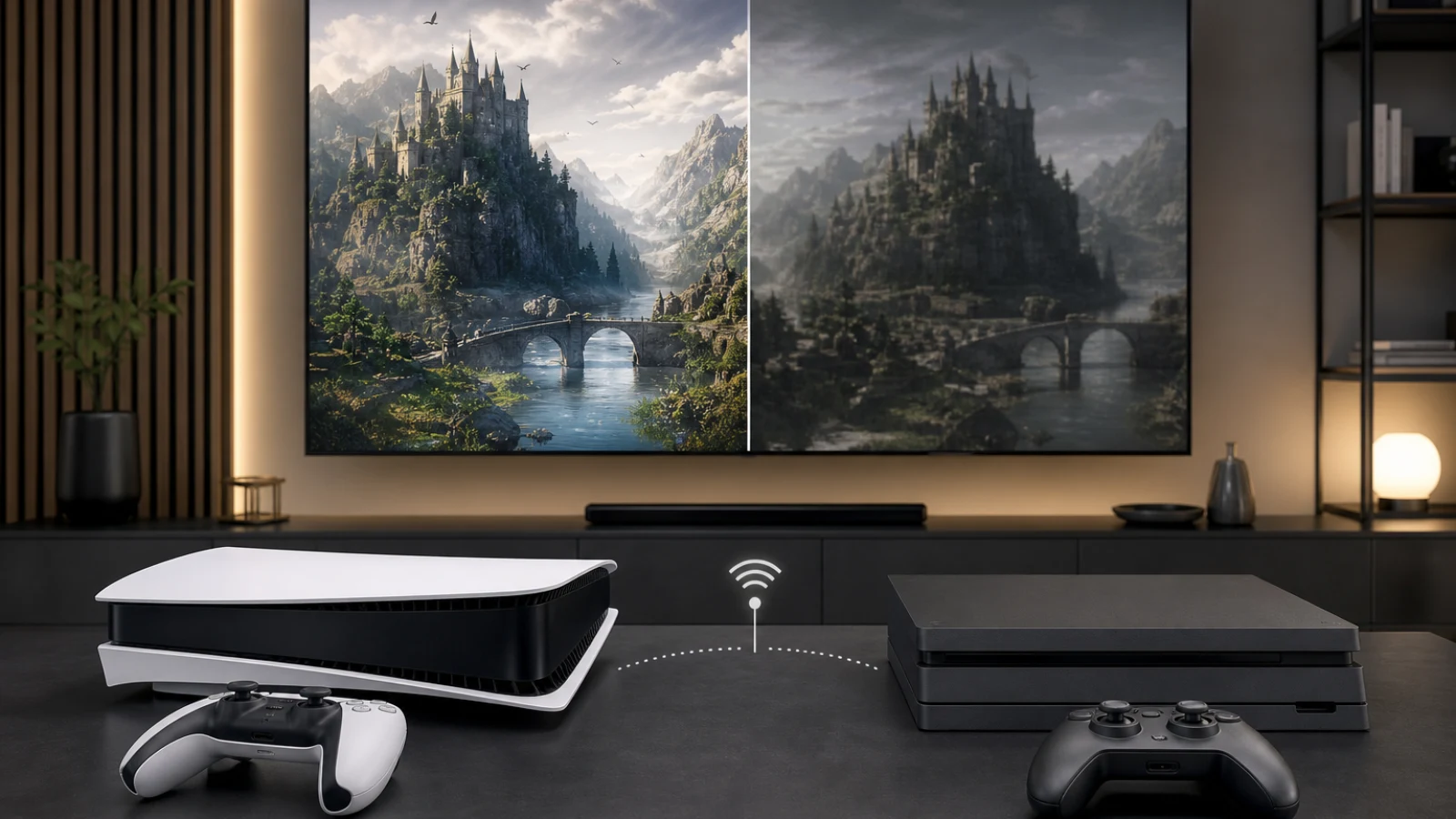
A standard PlayStation 5 can already run the entire PS5 game library, produce 4K output, support frame rates up to 120fps, and use HDMI variable refresh rate. The PS5 Pro does not unlock a separate generation of games. Instead, it tries to solve a familiar compromise within modern console games: choosing between a sharp, visually detailed 30fps mode and a smoother 60fps mode with reduced resolution or effects.
The short answer is that the PS5 Pro is technically better than the older PS5, but it is not automatically the better purchase. Its advantages are clearest in demanding games, on a good 4K television, and for players who notice resolution, ray tracing and frame-rate differences. The standard PS5 remains capable, significantly less expensive and, depending on the model, may include a disc drive.
PS5 Pro versus PS5 at a glance
| Feature | PS5 Pro | Standard PS5 family |
|---|---|---|
| Game library | PS5 games and supported PS4 games | Same PS5 and supported PS4 library |
| CPU | 8-core, 16-thread AMD Zen 2 | 8-core, 16-thread AMD Zen 2 |
| Graphics | Upgraded AMD Radeon RDNA-based GPU | AMD Radeon RDNA 2-based GPU |
| GPU rating | 16.7 TFLOPS | 10.3 TFLOPS on the established base design |
| Image reconstruction | PlayStation Spectral Super Resolution | Game-dependent conventional reconstruction |
| Ray tracing | Significantly upgraded | Supported, but less powerful |
| Internal storage | 2TB SSD | Varies by revision, commonly 825GB or 1TB |
| Wireless networking | Wi-Fi 7, with Wi-Fi 6 and Wi-Fi 5 compatibility | Wi-Fi 6 |
| Disc drive | Optional accessory | Built in on disc models; optional on compatible Digital models |
| Maximum output features | Up to 8K in select games; 4K/120Hz and VRR | 4K/120Hz, VRR and 8K-capable hardware support |
The numbers establish the Pro as the faster machine, but they do not mean every game runs 62% faster simply because 16.7 TFLOPS is roughly that much higher than 10.3. TFLOPS measure a particular category of theoretical arithmetic performance. Architecture, memory bandwidth, software design, upscaling and workload bottlenecks all influence actual results.
The main improvement is graphics performance
Sony designed the Pro around a larger and faster graphics subsystem rather than a new console generation. At its announcement, the company documented 67% more GPU compute units and 28% faster memory, resulting in up to 45% faster rendering under suitable conditions.
That extra capacity can be used in several ways:
- Raising the internal rendering resolution
- Holding a target frame rate more consistently
- Preserving detailed graphics settings at 60fps
- Adding or improving ray-traced reflections, lighting and shadows
- Creating additional 40fps, 60fps or 120fps display modes
The exact benefit is controlled by each game. A developer might use the hardware to make a standard PS5 performance mode look sharper, convert a 30fps presentation into a 60fps one, or add more ray tracing while retaining the original frame rate.
Independent evaluations reached a broadly consistent conclusion: the Pro can substantially reduce the usual fidelity-versus-performance compromise, but the visible difference is not equally dramatic in every title. Ars Technica found some improvements difficult to distinguish at a glance, while Digital Trends reported clearer images and greater stability alongside occasional PSSR quirks.
PSSR may matter more than the raw GPU number
PlayStation Spectral Super Resolution, or PSSR, is the Pro's dedicated image-reconstruction technology. A game can render internally at a lower resolution and use machine-learning-assisted processing to reconstruct a sharper output image. This saves GPU resources that can instead support higher frame rates, ray tracing or more complex scenes.
In a successful implementation, PSSR can make a 60fps mode resemble the sharper 30fps mode on a standard PS5. Fine geometry, distant scenery, hair and foliage can look more stable than they would with a basic spatial upscaler.
PSSR is not equivalent to rendering every pixel natively, and early implementations sometimes displayed flickering, ghosting or unstable fine details. The technology has continued to evolve, however. A March 2026 PS5 system update introduced upgraded PSSR support with improved motion stability, detail clarity and image consistency. PS5 Pro owners can also apply the enhanced version through a system setting to existing Pro games that support PSSR, although Sony warns that results vary by title.
This software improvement matters because it means the Pro's image quality is not frozen at its November 2024 launch state. At the same time, PSSR remains dependent on developer support and game-specific implementation. It does not make every unpatched PS5 game look like a newly remastered release.
Ray tracing is faster, but still involves trade-offs
Ray tracing simulates selected paths of light to create more convincing reflections, shadows and illumination. It is computationally expensive, which is why base PS5 games often reserve their most advanced ray-tracing effects for 30fps fidelity modes.
Sony says the PS5 Pro can calculate rays at double—and in some situations triple—the speed of the base console. This does not guarantee comprehensive ray tracing at 4K and 60fps in every game. Developers still choose which effects to use, how many rays to calculate and whether the final image is reconstructed from a lower internal resolution.
In practical terms, Pro enhancements may provide more accurate reflections, longer reflection distances, improved shadow quality or ray-traced effects at 60fps. These differences are often most noticeable in glossy city environments, wet surfaces, glass, vehicles and games with dramatic lighting.
The CPU is not a generational upgrade
Both consoles use an eight-core, 16-thread AMD Zen 2 CPU. The PS5 Pro's official specifications confirm that its processor remains within the same architectural family as the standard machine.
That makes the Pro primarily a graphics upgrade. Games limited by GPU rendering can benefit considerably, but games restricted by CPU-heavy simulation, artificial intelligence, physics or world processing may improve less. A title that struggles to reach 60fps because of CPU demand will not necessarily become a locked 60fps experience simply by running on the Pro.
This distinction also explains why the PS5 Pro is a mid-generation enhancement rather than a PS6. It improves presentation and GPU-bound performance without replacing the basic software platform or changing what games developers can release for the PS5 generation.
Enhanced games receive the biggest benefits
All PS5 games can run on the PS5 Pro, but the strongest results generally come from titles carrying the PS5 Pro Enhanced designation. These games include developer-created settings or patches designed around the upgraded hardware.
The type of enhancement varies. One game may combine fidelity-level detail with 60fps, while another may use the extra power for better ray tracing or a sharper 120fps mode. The official PS5 Pro product page therefore notes that features differ by title.
Unpatched games can still benefit from PS5 Pro Game Boost when they have dynamic resolution, inconsistent frame rates or otherwise unused performance headroom. The effect may be modest, however, and locked settings remain locked unless the developer changes them.
The console also includes an optional image-quality enhancement for compatible PS4 games. It requires a 1440p or 4K display and can be disabled if it creates unexpected behavior.
A suitable television makes a major difference
The Pro's upgrades are easiest to appreciate on a large, high-quality 4K screen. A 120Hz television or monitor with HDMI variable refresh rate can expose additional display modes and smooth out fluctuations in supported games. Sony confirms that PS5 consoles support HDMI 2.1, 4K at 120Hz and VRR.
The Pro is less compelling when connected to:
- A 1080p television
- A small screen viewed from far away
- A display without HDR, 120Hz or VRR
- A television with weak motion performance or poor contrast
PS5 Pro can output games at up to 8K, but only selected titles support it. Sony's compatibility guide also states that the system interface, media applications and recorded gameplay clips remain limited to 4K. Consequently, 8K should be treated as a specialized feature rather than the main reason to upgrade.
Storage and connectivity are genuinely better
PS5 Pro includes a 2TB custom SSD, whereas older PS5 revisions generally provide 825GB or 1TB. Some capacity is reserved for system functions on every model, but the Pro still provides substantially more usable space for installed games.
Both console families support storage expansion. Sony currently permits compatible PCI Express 4.0 M.2 NVMe drives from 250GB to 8TB, with a suitable heat-dissipation mechanism. An existing compatible M.2 drive can be moved from an older PS5 to a Pro without formatting it again.
Wireless connectivity also advances from Wi-Fi 6 to Wi-Fi 7. With a compatible Wi-Fi 7 router and favorable network conditions, this can provide more usable wireless bandwidth, lower latency and better stability. It will not improve a game's rendering performance, and both systems retain gigabit Ethernet, which remains the predictable option for fixed installations.
The missing disc drive changes the value calculation
PS5 Pro is sold as a digital console. Owners of physical PS4 or PS5 games must add Sony's detachable disc drive, which is compatible with CFI-2000 and CFI-7000 systems. An internet connection is required to pair the drive during setup.
A vertical stand is also sold separately, although horizontal feet are included. Existing covers made for the original or slim PS5 do not fit the Pro.
These omissions matter to anyone with a disc collection or a preference for used games, lending and physical movies. A standard disc-equipped PS5 is simpler and may cost substantially less than a fully equipped Pro.
As of July 23, 2026, PlayStation Direct's US console listings show the 2TB PS5 Pro at $899, the 1TB disc PS5 at $649 and the 825GB Digital Edition at $599. Prices and bundles can change, but that official gap illustrates the central buying decision: the Pro charges a large premium for better image quality and performance rather than access to different games.
Is upgrading from an existing PS5 worthwhile?
The PS5 Pro makes the most sense for someone who:
- Uses a large 4K, 120Hz display with VRR
- Frequently chooses 60fps performance modes but dislikes their softer image
- Plays graphically demanding Pro-enhanced games
- Values ray tracing and image clarity more than physical-media support
- Needs more internal storage and would otherwise buy an M.2 SSD
- Is willing to pay a premium for the strongest version of the current PS5 experience
Keeping an older PS5 is usually more sensible when its owner:
- Is already satisfied with 30fps fidelity or 60fps performance modes
- Plays mainly competitive, independent or less demanding games
- Uses a 1080p display or a modest 4K television
- Owns many physical games and already has a built-in drive
- Expects a dramatic, next-generation visual transformation
Migration is relatively straightforward. Sony supports console-to-console transfer of accounts, games, saves, captures and selected settings. USB game storage and compatible M.2 SSDs can also be moved to the new system.
Conclusion
The PS5 Pro is unquestionably the better-performing PS5. Its faster GPU, improved ray tracing, upgraded PSSR, 2TB SSD and Wi-Fi 7 reduce graphical compromises and can make demanding games look sharper at higher frame rates.
The standard PS5 is still the better value for many consumers because it plays the same games and already delivers strong 4K performance. The Pro is best understood as an enthusiast upgrade: meaningful on the right display and in the right games, but neither essential nor comparable to moving to a completely new console generation.
Resource credits
- Welcome PlayStation 5 Pro, the most visually impressive way to play games on PlayStation — PlayStation Blog
- PlayStation 5 Pro — PlayStation
- PlayStation 5 Pro Safety Guide and Specifications — Sony Interactive Entertainment
- New look for PS5 console this holiday season — PlayStation Blog
- Upgraded PSSR rolling out to supported PS5 Pro games — PlayStation Blog
- PS5 Pro Compatibility Guide — PlayStation Support
- How to Change PS5 Console Resolution — PlayStation Support
- How to Enhance Image Quality for PS4 Games on PS5 Pro — PlayStation Support
- How to Add an M.2 SSD to a PS5 Console — PlayStation Support
- Transfer Data from a PS4 Console or PS5 Console to Your PS5 Console — PlayStation Support
- Shop PS5 Consoles and Bundles — PlayStation Direct
- The PS5 Pro’s Biggest Problem Is That the PS5 Is Already Very Good — Ars Technica
- PlayStation 5 Pro Review: PS5 Upgrade Delivers Few Compromises at a Cost — Digital Trends
Join the discussion
Share your thoughts or questions with the Tech Steve community.
Log in to discuss