

History of TCL CSOT TVs: How Panel Manufacturing Made TCL Different
TCL’s television history is closely tied to TCL CSOT, the display-panel manufacturer founded in 2009. Its large-generation LCD factories, HVA panels, Mini LED backlights and vertical supply chain helped TCL move from value-oriented televisions into large-screen premium models. Understanding that relationship also reveals the limits of labels such as QLED, Mini LED and “CSOT panel.”
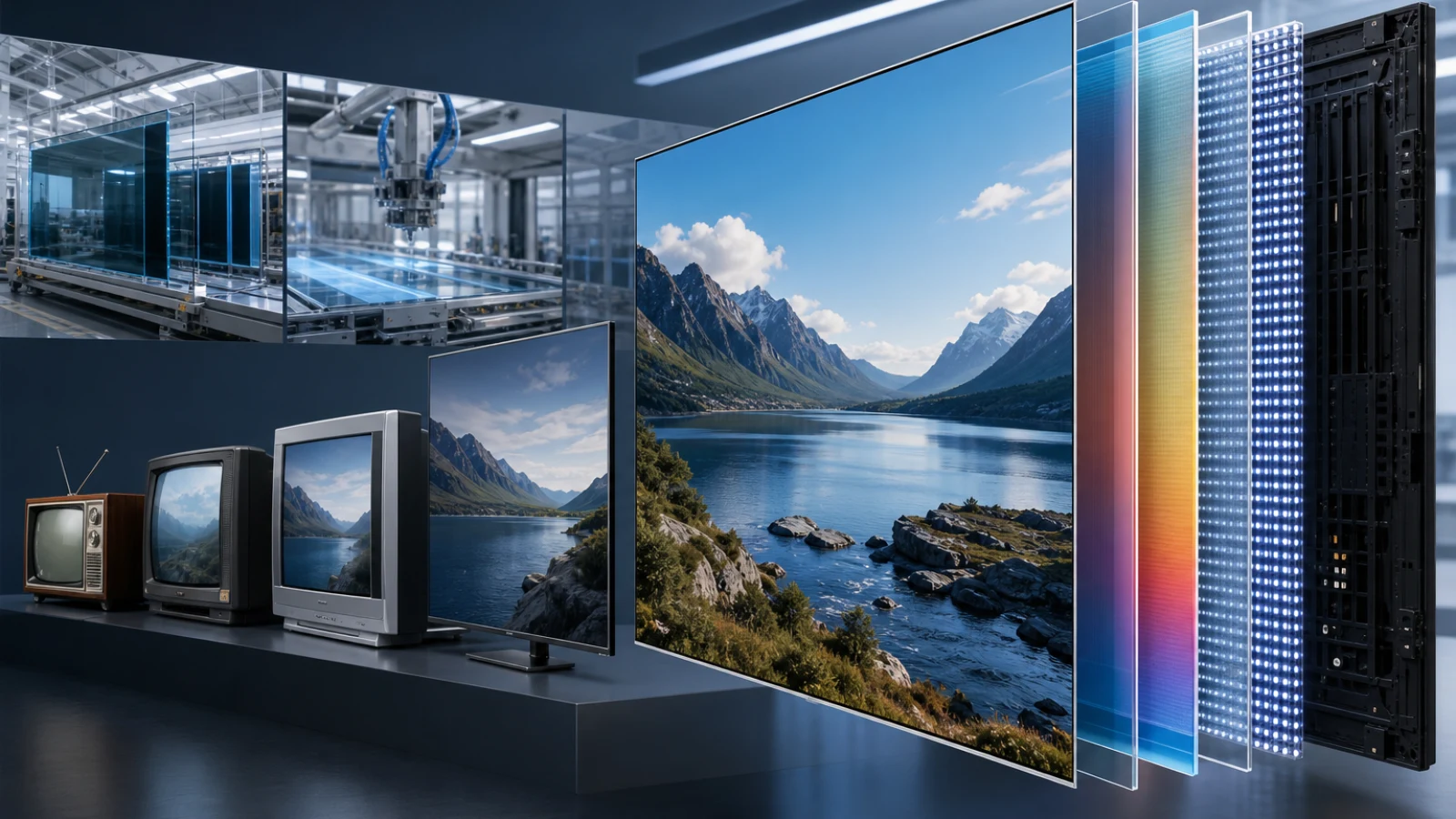
A modern TCL television may carry terms such as QD-Mini LED, HVA or CSOT panel, but those names describe different parts of the product. TCL Electronics develops and markets finished televisions, while TCL CSOT—short for China Star Optoelectronics Technology—manufactures display panels and modules for TCL and other brands.
That relationship is central to TCL’s history. Instead of remaining primarily a television assembler that purchased its most expensive component from outside suppliers, TCL invested heavily in making LCD panels. The resulting combination of panel production, backlight development and television assembly helps explain TCL’s strength in large, bright LCD TVs. It does not, however, mean every TCL model uses identical technology or that a CSOT panel automatically guarantees excellent picture quality.
From Chinese TV maker to global manufacturer
TCL traces its corporate history to 1981, although the TCL brand was formally introduced later. Its early television milestone was a 28-inch color model launched in China in 1993, according to the company’s corporate history.
International expansion accelerated in 2004 through an agreement with France’s Thomson. The companies combined television manufacturing, development and distribution assets in a new operation called TTE. Thomson contributed factories and research facilities in several countries, while TCL obtained a much broader manufacturing and sales footprint. Contemporary Thomson regulatory filings record that TTE became operational on August 1, 2004.
This mattered because television manufacturing was shifting rapidly from bulky cathode-ray tubes to flat-panel LCDs. TCL gained global scale, but the LCD panel—the defining and often most expensive part of a flat-screen television—still came from a relatively small group of specialist suppliers.
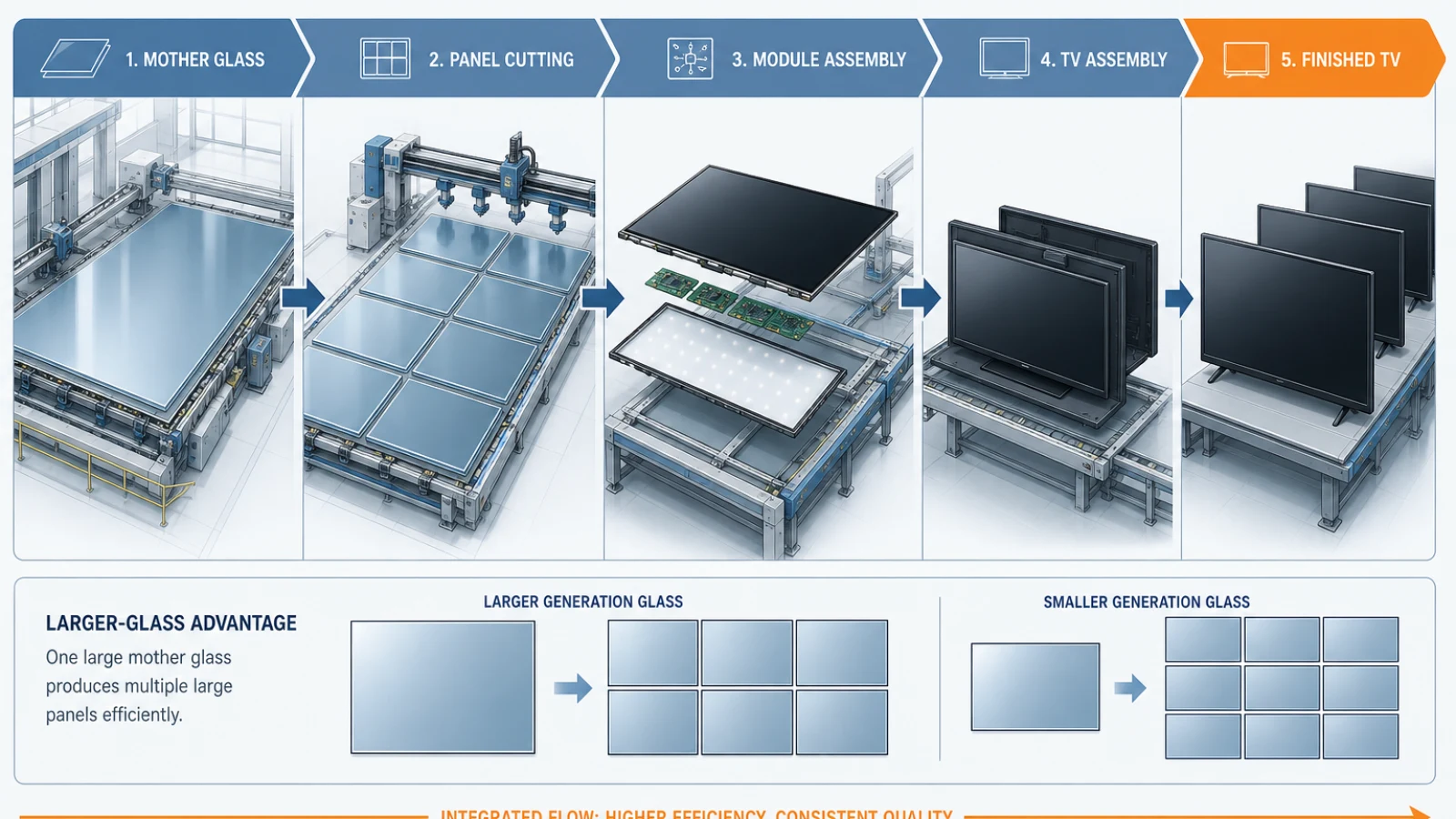
High-generation LCD lines process large sheets of mother glass into multiple TV panels, linking panel fabrication, module assembly and finished-TV production.
The creation of TCL CSOT
TCL entered semiconductor-display manufacturing by establishing CSOT in 2009. The first project, known as t1, was an 8.5-generation LCD production line in Shenzhen. Trial and volume production followed in 2011, and the operation reached its targeted monthly output in 2012, according to the official CSOT development timeline.
The “generation” of an LCD factory refers primarily to the size of the mother glass processed by the production line, not the age or resolution of the finished screen. Larger sheets can be divided efficiently into several television panels. For comparison, a Generation 10.5 substrate can accommodate six 75-inch panels, as explained by display-equipment manufacturer Applied Materials.
This manufacturing economy became increasingly important as consumers moved toward 55-, 65- and 75-inch televisions. CSOT later added Generation 11 facilities designed for large LCD panels, helping the wider TCL organization produce very large screens at greater scale.
In 2018, CSOT also began producing high-generation panel modules in Huizhou. TCL described the project as part of a strategy to connect panel, module and finished-TV manufacturing more closely. The module-production announcement is one of the clearest documented statements of TCL’s vertical-integration strategy.
A corporate distinction is worth noting. A 2019 restructuring separated TCL Technology, which contains the semiconductor-display business, from TCL Industries, which focuses on consumer products. TCL TVs and TCL CSOT therefore belong to a shared industrial ecosystem, but they are not simply two names for one operating company.
Roku TV and TCL’s consumer breakthrough
Panel production was only part of TCL’s rise. In 2014, TCL became one of the first hardware partners for Roku TV. Roku supplied a simplified smart-TV platform while TCL supplied the television hardware. The original Roku TV announcement identified TCL models for release later that year.
The partnership mattered because inexpensive televisions often had slow or confusing software. Combining competitive hardware with an established streaming interface gave TCL a clearer identity in North America. It also demonstrated that panel technology alone does not make a successful television; operating-system support, processing, connectivity and retail distribution are equally important.
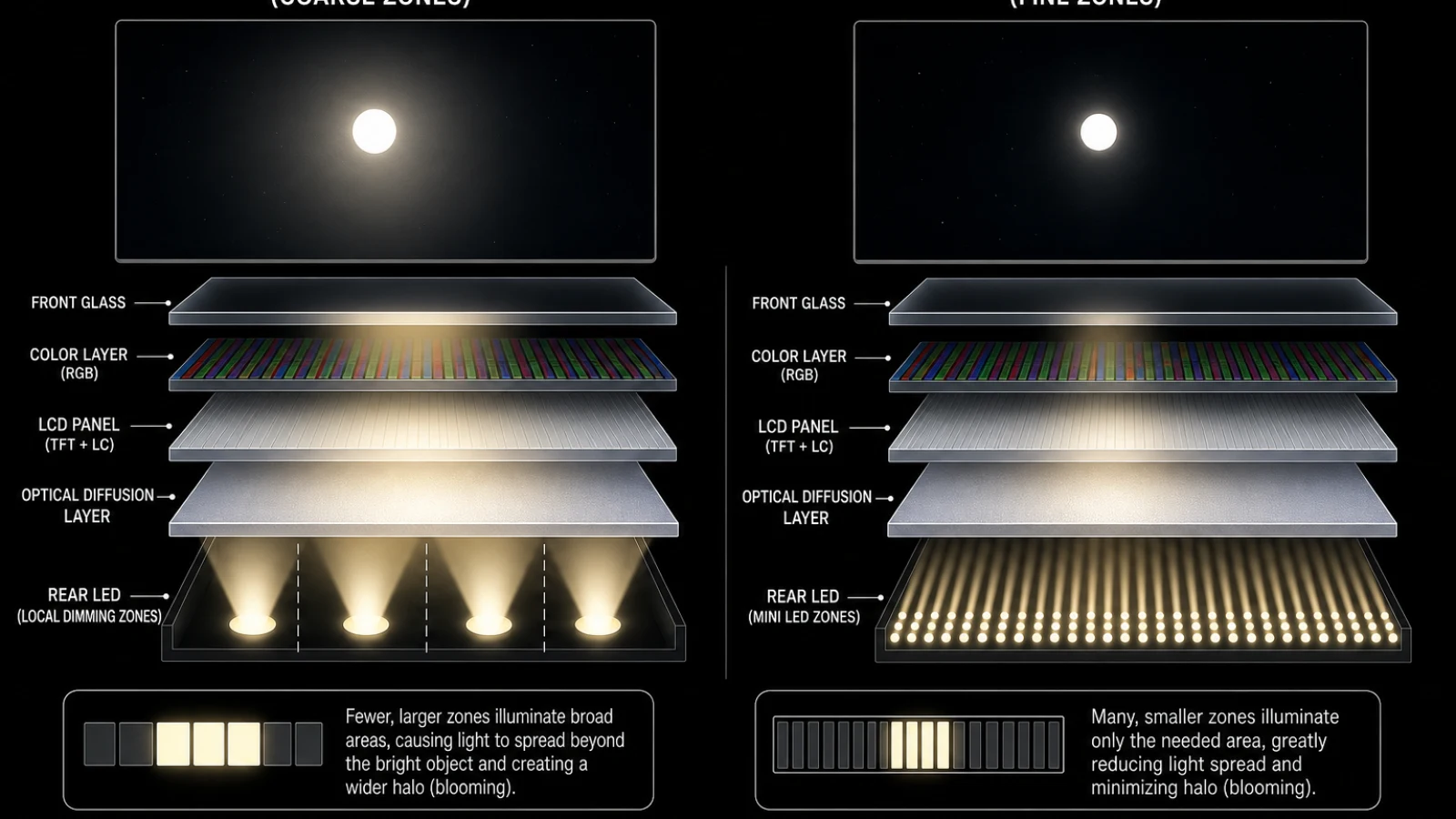
Mini LED televisions remain LCDs, but many smaller backlight zones can illuminate bright areas more precisely while reducing—though not eliminating—haloing.
Mini LED changes the premium LCD formula
TCL’s most influential display milestone came with Mini LED backlighting. The company dates its first local-dimming television to 2016, began dedicated Mini LED development in 2018 and launched its first Mini LED televisions in 2019. This resolves a common timeline mix-up: 2016 was the earlier local-dimming milestone, while 2019 was the commercial Mini LED launch, as outlined in TCL’s display-technology history.
The 2019 TCL 8-Series used more than 25,000 small LEDs divided into roughly 1,000 dimming zones on the 75-inch model. TCL and independent technical histories identify it as the first consumer television marketed with a Mini LED backlight. Its archived 8-Series product page documents the original implementation.
Mini LED is not a self-emissive display like OLED or MicroLED. It remains an LCD television, but replaces a relatively coarse backlight with many smaller light sources. More controllable zones can increase brightness and improve dark-scene contrast, although bright objects may still produce halos when they are smaller than a dimming zone. IEEE Spectrum’s Mini LED explanation provides a useful technical distinction between the LCD panel and its backlight.
TCL followed in 2021 with OD Zero, a design that reduced the optical distance between the Mini LED backlight and LCD layer. The goal was a thinner structure with more precise light distribution, rather than a fundamentally new panel type. TCL’s OD Zero documentation describes the optical and backlight changes.
HVA panels, quantum dots and very large screens
CSOT’s HVA technology is a variation of vertical-alignment LCD. VA panels are generally valued for strong native contrast because their liquid crystals can block backlight effectively in dark scenes. CSOT says HVA modifies the pixel structure and manufacturing process to reduce dark-state light leakage, improve brightness efficiency and support high refresh rates. Later WHVA versions aim to improve the narrower viewing angles traditionally associated with VA screens. The manufacturer’s HVA technical overview explains those design priorities.
Quantum-dot terminology describes another layer. A conventional QLED or QD-Mini LED television is still an LCD. Quantum dots convert light into narrower red and green wavelengths, helping the television reproduce a wider range of saturated colors. They do not provide pixel-level illumination in the way OLED pixels do. The RTINGS QLED guide offers a useful consumer-oriented explanation of this frequently misunderstood label.
Combining HVA panels, quantum-dot color conversion and dense Mini LED backlights allows TCL to target high brightness, strong contrast and large screen sizes without using OLED. CSOT’s high-generation factories also make 98- and 115-inch LCD televisions more practical to manufacture. This is arguably the most visible consumer result of TCL’s panel investments: advanced LCD features and unusually large screens can move into lower price tiers more quickly.
Acquiring Samsung’s LCD assets
TCL CSOT expanded further as Samsung Display withdrew from LCD manufacturing. TCL Technology completed its acquisition of Samsung’s Suzhou LCD and module operation in 2021. In August 2022, CSOT also acquired 577 related US LCD patents, according to TCL’s announcement about the transaction.
CSOT subsequently became a panel supplier for Samsung-branded televisions as well as TCL products. That illustrates an important point: CSOT is an independent display supplier within the TCL industrial group, not merely an internal factory producing screens exclusively for TCL TVs.
What is genuinely different for consumers?
The documented distinction is TCL’s access to a large, closely related panel-manufacturing operation. That can provide several advantages:
- Earlier access to CSOT technologies such as HVA and WHVA panels
- Greater control over the interaction between the LCD panel, backlight and local-dimming software
- Economies of scale in 65-inch and larger televisions
- The ability to offer Mini LED across more price levels
- A supply chain that also generates revenue by serving competing TV brands
The reasonable consumer interpretation is more limited. Vertical integration can improve cost and development speed, but it does not guarantee uniformity, accurate image processing or flawless quality control. Dimming-zone count, native refresh rate, screen coating, video processor, software support and factory calibration can differ substantially between TCL series and regional versions.
TCL’s scale confirms that the strategy had a broad market effect. For 2025, the company reported—citing Omdia—that TCL ranked second in global TV shipments and first in Mini LED TV shipments. Those figures appear in TCL Electronics’ 2025 results.
Conclusion
TCL CSOT transformed TCL from a company primarily associated with finished televisions into one backed by a major display-panel manufacturer. Its high-generation LCD factories, HVA panel development and early commercialization of Mini LED helped make bright, large-screen LCD TVs more widely available. The meaningful difference is not a single logo or specification, but the combination of manufacturing scale and panel-to-TV engineering. Buyers should still evaluate the exact model, because the CSOT connection is an advantage in resources—not a substitute for measured picture quality.
Resource credits
- About TCL Technology and Corporate Milestones — TCL Technology
- History of Relationship With TCL/TTE — Thomson SEC Filing
- TCL CSOT Company Profile and Development History — TCL CSOT
- Applied Materials Selected for Gen 10.5 LCD Production — Applied Materials
- CSOT Commences Production of High-Generation Panel Modules — TCL
- Roku Introduces Roku TV — Roku
- TCL Advanced Display Technology History — TCL Global
- TCL 8-Series Mini LED Television — TCL USA
- What Is Mini-LED TV? — IEEE Spectrum
- TCL OD Zero Mini LED Technology — TCL
- HVA Technology — TCL CSOT
- What Is QLED? — RTINGS.com
- CSOT Acquires Samsung LCD Patents and Suzhou Plant — TCL
- TCL Electronics 2025 Global Results — TCL Global
Join the discussion
Share your thoughts or questions with the Tech Steve community.
Log in to discuss